ЦецоNOL написа: 12.06.2026, 17:58:48
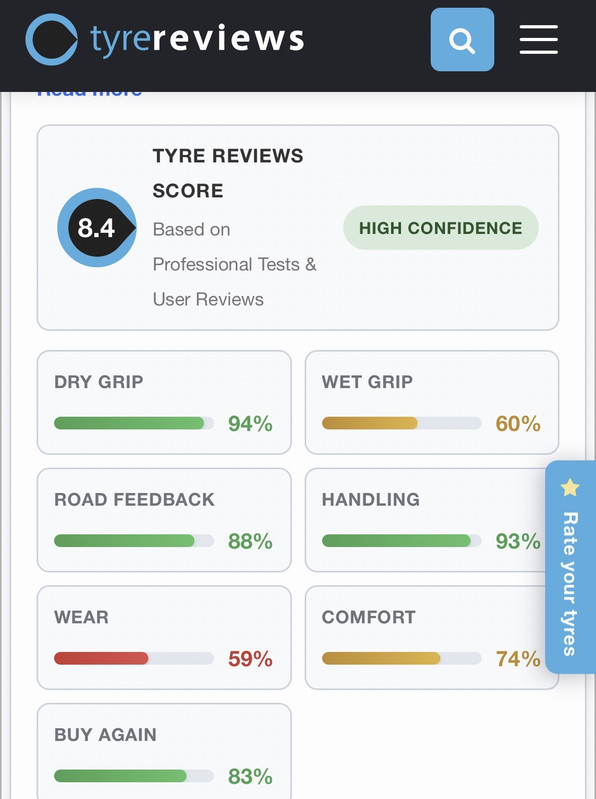
на каква база са тия данни
Ето как ги тестват и оценяват на мокро:
https://www.tyrereviews.com/Article/Tes ... dology.htm
Wet Braking
For wet braking, I drive the test vehicle at an entry speed of 88 km/h and apply full braking effort to a standstill with ABS active on an asphalt surface with a controlled water film. I measure braking performance using Racelogic VBOX equipment only, excluding the brake pressure build-up phase from the measured window. I typically use an 80-5 km/h measurement window to isolate tyre performance from variability in the initial brake application. My standard programme is eight runs per tyre set, although the sequence can extend to as many as fifteen runs if conditions and tyre category justify it. I analyse the full set of runs and discard statistical outliers before averaging. To correct for changing conditions, I run reference tyres repeatedly throughout the session - in wet testing, typically every three candidate test sets.
Wet Handling
For wet handling, I drive at the limit of adhesion around a dedicated handling circuit. I generally use specialist wet circuits with kerb-watering systems designed to maintain a consistent surface condition, rather than conventional sprinkler-based wetting. ESC is disabled where possible so I can assess the tyre's natural balance, transient response, and limit behaviour without electronic intervention masking the result. I usually complete between two and five timed laps per tyre set, depending on the circuit, tyre type, and consistency of conditions. I exclude laps affected by clear driver error, traffic, yellow flags, or obvious environmental inconsistency. Control runs are carried out frequently throughout the session, and I often use multiple sets of control tyres so that wear on the references does not become a meaningful variable.
Straight-Line Aquaplaning
To measure straight-line aquaplaning resistance, I drive one side of the vehicle through a water trough of controlled depth, typically around 7 mm, while the opposite side remains on dry pavement. I enter at a fixed speed and then accelerate progressively measuring the differing wheel speeds. I define aquaplaning onset as the point at which the wheel travelling through the water exceeds a specified slip threshold relative to the dry-side reference wheel. I usually perform four runs per tyre set and average the valid results.
Curved Aquaplaning
Curved aquaplaning is assessed by driving the test vehicle through a flooded corner at progressively increasing speeds and measuring the speed at which the rear of the vehicle loses lateral grip. This tests the tyre's ability to resist aquaplaning under lateral load, which is a different and arguably more safety-critical scenario than straight-line aquaplaning. I use GPS telemetry to log the critical speed, and reference tyres are run at intervals to correct for changing water depth and surface conditions.
Subjective wet handling
Jonathan Benson also scores steering response, breakaway characteristics, confidence, and overall behaviour at the limit on wet surfaces.
So when you see a tyre ranked highly for "wet grip" on Tyre Reviews, it's usually the result of a combination of:
= Wet braking performance
= Wet handling lap times
= Aquaplaning resistance
= Driver-assessed wet behaviour
rather than a single measurement. In many of their comparison tests, wet braking and wet handling carry the largest weight within the wet-performance category.